
Citizens Pushing Back
The United States has more than 3,000 operational data centers now. More than 1,500 new data centers are in various stages of development nationwide. As demand for artificial intelligence accelerates, citizens are standing up for common sense.
Data centers are huge industrial buildings that house computer servers, data storage systems, and networking equipment. They act as the physical backbone of the internet, powering online tools, including cloud storage, applications, banking, and artificial intelligence (AI).
Fears that these centers will increase electricity prices, deplete water supplies and compete for farmland have prompted people across the country to pack meetings of zoning boards and county commissions to oppose the projects, while fueling calls from leaders in both parties for state or national moratoriums. That opposition has become a rising obstacle for an industry that is developing an estimated 1,500 data centers, in large part to support the growth of artificial intelligence.
- 67 percent of planned data centers are in rural areas, while 87 percent of existing data centers are in urban ones.
- 39 percent of planned data centers are in counties that don’t have any today.
Most of the planned construction of U.S. data centers will happen in the South and Midwest. Three-quarters of all planned data centers will be built in these two regions, with the South alone accounting for nearly half of them (48 percent).
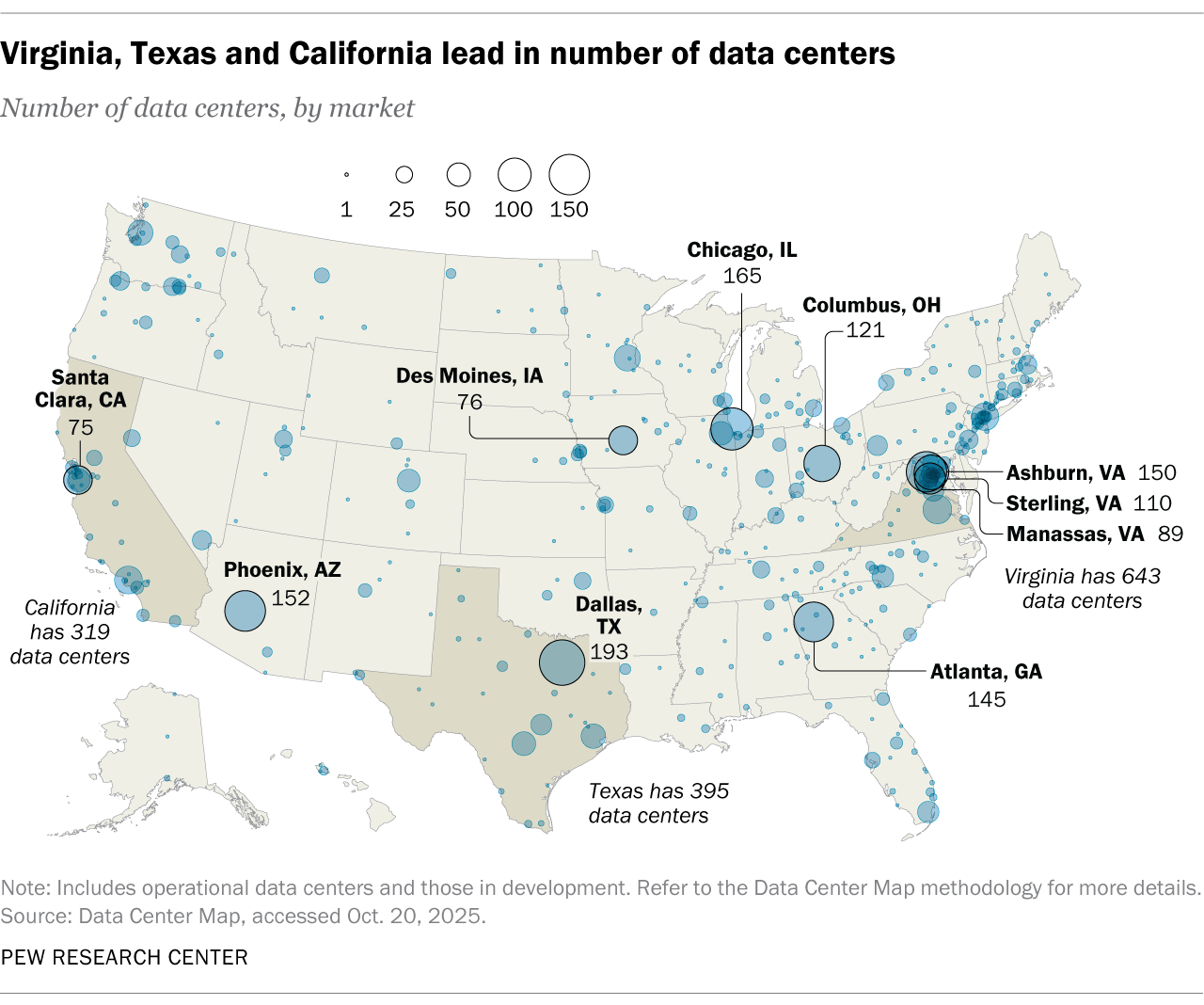
Virginia and Texas have the most planned data centers (287 and 170, respectively). They are followed by Georgia (141), Illinois (123) and Arizona (86). Virginia and Texas also have the most currently operating data centers (398 and 296, respectively). They are followed by California (277), Ohio (166) and New York (148).
Currently, 38 percent of Americans live within 5 miles of at least one operational data center.
These structures tend to be built in clusters: Nine-in-ten data centers are within 5 miles of another one. As a result, a majority of Americans who live near one data center also live near at least one more.
Another 4 percent of Americans don’t live near a currently operational data center but live within 5 miles of one that’s planned. That means 42 percent of the population lives close to an existing or planned data center. Most Americans have similar views about the impact that data centers have on things like the environment, home energy costs and local jobs.
They have become a major flashpoint of controversy—particularly with the massive boom in AI infrastructure—due to several key environmental, economic, and social concerns. For example, data centers require immense amounts of electricity to run servers and cooling systems 24/7, straining local power grids and driving up utility bills for nearby residents. Traditional facilities use millions of gallons of water for evaporative cooling, raising scarcity concerns in drought-prone areas.
The AI boom is compelling data center companies to communicate more with the public
Many of the messaging battles have been local. Patrick Hughes, a senior vice president for the National Electrical Manufacturers Association, said the resistance is particularly fierce when a company doesn’t provide information to communities before breaking ground on a construction project.
“Where projects go astray is when the community finds out because a plot of land is being cleared and construction is already going,” Hughes told POLITICO. “At that point, it’s already too late to have that conversation around how this is going to benefit people.”
Noise and Infrastructure: Large cooling fans and backup generators (often powered by natural gas) create constant noise pollution.
Industrial Footprint: These massive complexes alter rural or residential landscapes, increasing traffic, emissions, and local air pollution.
Few Local Jobs: Despite their massive size, completed data centers employ relatively few permanent workers.
Tax Breaks vs. Public Cost: Tech companies often secure heavy government tax incentives, meaning local taxpayers may shoulder the burden of upgrading public roads, water lines, and electrical grids without seeing proportional tax revenue.
Many residents view data centers as an unwelcome physical incursion by Big Tech, serving an AI industry that yields profits for private corporations while imposing local costs.
“Data center companies aren’t marketing a consumer product,” said Wes Cummins, chairman and CEO of the data center developer and operator Applied Digital. “You don’t typically have a big PR department that has dealt with anything like this before.”
Data centers typically keep their plans quiet. Nondisclosure agreements with local officials have been common practice. Such agreements have recently compounded the problem with citizens in places such as Salem, Oregon, and Posey, Indiana.
“When [data center companies] have gone into communities, they’ve had those municipalities enter into non-disclosure agreements, so the data around consumption have been in a black box,” said Michelle Lopes Maldonado, associate director of AI policy at the Information Technology and Innovation Foundation. “It’s when we don’t share the full picture that people start to fill in the gaps with their own information.”
Higher electricity costs, for example, are Americans’ top concern when it comes to building data centers, the results show. In January, 43 percent of Americans said they believe that “data centers raise people’s electricity bills.” This month, that share jumped 16 points to nearly 60 percent of Americans who said the same.
U.S. data centers consumed 183 terawatt-hours (TWh) of electricity in 2024, according to IEA estimates. That works out to more than 4 percent of the country’s total electricity consumption last year – and is roughly equivalent to the annual electricity demand of the entire nation of Pakistan. By 2030, this figure is projected to grow by 133 percent to 426 TWh.
As of 2024, natural gas supplied over 40 percent of electricity for U.S. data centers, according to the IEA. Renewables such as wind and solar supplied about 24 percent of electricity at data centers, while nuclear power supplied around 20 percent and coal around 15 percent.
Natural gas is projected to continue supplying the largest share of energy at data centers through 2030, but nuclear power could eventually play a larger role. Several tech companies have recently announced purchasing agreements with nuclear power startups. Plans are also in the works to revive two retired nuclear power plants – Three Mile Island in Pennsylvania and Duane Arnold in Iowa – to meet growing energy demand from data centers.
One study from Carnegie Mellon University estimates that data centers and cryptocurrency mining could lead to an 8 percent increase in the average U.S. electricity bill by 2030, potentially exceeding 25 percent in the highest-demand markets of central and northern Virginia.
The share of Americans who said data centers deplete the water supply grew from 34 percent to 55 percent during the same period.
Spreading the message on data centers’ purported benefits and costs has been a challenge, according to Software and Information Industry Association President Chris Mohr. He told POLITICO that the industry broadly needs to work on getting that information to local government leaders, who are often in the best position to communicate with residents.
“Local communities have been vocal about these projects,” said Mohr. “It’s imperative that their leaders be armed with facts.”
Statewide Moratoriums Under Consideration
Democratic New York Gov. Kathy Hochul signed an executive order in July establishing the United States’ first statewide pause on large data center construction, and progressives in Congress have proposed such a moratorium for the nation.
New York became the first state in the nation to enact a statewide moratorium on certain AI data center development projects—marking a significant departure from the local and municipal restrictions that have characterized regulatory responses to date. Others have followed its example. Others??? Maine?
While the immediate impact on nationwide data center growth may be limited, the move could mark a change in how states approach the future of AI infrastructure.
Historically, efforts to slow or pause data center growth have occurred at the municipal or county level, often driven by local concerns surrounding energy consumption, land use, water resources, and community impact. New York’s action is notable because it represents the first statewide moratorium of its kind.
The development bears close watching as several other states—including Minnesota, Michigan, Pennsylvania, South Carolina, New Hampshire, and Virginia—are considering legislation that could impose similar restrictions on future data center projects. If additional states follow suit, New York’s decision could become the beginning of a broader regulatory trend rather than an isolated event.
New York’s moratorium might be the first salvo in a broader conversation about how states regulate the AI economy. Growing local opposition to data center projects, combined with increased legislative activity at the state level, has elevated regulatory risk as a key factor in development planning. Industry participants—including data center developers, hyperscalers, and emerging AI infrastructure providers—are closely monitoring state legislative developments as they evaluate where to deploy capital and build new facilities.
In addition to the moratorium, New York Governor Kathy Hochul has indicated plans to pursue repeal of the state’s sales tax exemption for large data centers. Such a change could significantly affect project economics.
For facilities currently under development—or those in the planning stages—the loss of these exemptions could increase costs associated with purchasing critical equipment and construction materials. This includes major infrastructure investments such as long-lead electrical equipment, as well as high-value computing hardware like GPUs and CPUs that are central to AI workloads.
Developers might face both regulatory uncertainty and increased capital expenditures, potentially reshaping investment decisions in the state. New York’s moratorium represents an important milestone in the evolving regulatory landscape surrounding AI infrastructure.
At least twenty-seven states are advancing state data center legislation that requires developers to cover data center energy costs and report usage, with California, Ohio, and Utah already enacting laws that go beyond the federal government’s voluntary Ratepayer Protection Pledge.
On March 4, 2026, in conjunction with the White House, several major data center developers signed the Ratepayer Protection Pledge, committing to cover the full cost of new electric generation resources needed to meet their energy demands. The pledge addresses one of the central concerns driving state legislation, though it does not have a legal enforcement method, and does not appear to have stalled state legislation moving forward.
Maine is poised to become the first state to implement data center construction moratoriums, pausing new projects until November 2027, with several other states and localities considering similar measures despite federal efforts to speed up development.
In July 2025, President Trump issued an executive order to rapidly and efficiently build out data center infrastructure by “easing federal regulatory burdens.” The order applies to data centers requiring more than 100 MW new electricity load, costing at least $500 million to build, or those that protect national security. The order attempts to streamline environmental review and permitting processes, orders the Secretary of Commerce to provide financial support and incentives for qualifying data center projects, and allows the Secretaries of Defense, Interior, Commerce, or Energy to designate other data center projects subject to the order, but does not lay out any criteria to determine which projects qualify.
The order’s reach is limited to federal policies. It does not preempt state permitting requirements, zoning laws, or energy regulations, meaning a data center that meets federal requirements can still face significant state and local challenges. The order does not impact state and local policymakers’ authority over land use or utility regulations.
On social media, Trump urged the U.S. to “let Data Reign.” He stated that data centers bring jobs, lower taxes, and wealth, and warned that stopping them helps China win the AI race. He warned that towns that reject them risk ending up “backwards and poor.”
As opposition to datacenters grows, the research group Data Center Watch found that grassroots groups blocked or delayed at least 75 datacenter projects worth approximately $130 billion in the first three months of 2026.

Crossbow Communications is an award-winning public affairs and government affairs firm. We specialize in public health and environmental issues. We serve the world.

